Digital Foundry published its full performance analysis of Grand Theft Auto VI on November 20, 2026, and its answer to the launch week's biggest technical question is the processor, not the graphics chip. The game's NPC crowds, and the AI that runs them when panic breaks out, saturate the Zen 2 CPUs inside every current console, and in the worst scenes the frame rate dives into the 20s and stays there. DF's Oliver Mackenzie doubts even the future PC version will run at a perfectly consistent 60 frames per second on decent hardware. What DF found, what it means for a 60 FPS patch, and what it means for PC.
What DF published
The starting fact is not in dispute. Rockstar confirmed before launch that Grand Theft Auto VI runs at 30 frames per second on every console, PlayStation 5, PlayStation 5 Pro and both Xbox Series machines, with no 40 or 60 FPS performance mode, and Digital Foundry's launch-week testing found exactly that: a game that, in its words, "targets 30fps" on every platform. What DF's analysis, published November 20, 2026, set out to explain is why, and the short answer is that the limit sits in the processor, not the graphics chip.
The analysis, written up by DF's William Judd from Oliver Mackenzie's video testing, walks through the scenarios that push the game hardest and isolates what breaks first. TweakTown reported the same findings the same day. The conclusion matters beyond the consoles, because it speaks directly to the two hopes players are holding: a future performance patch, and the PC version Rockstar has not yet announced.
The crowds are the bottleneck
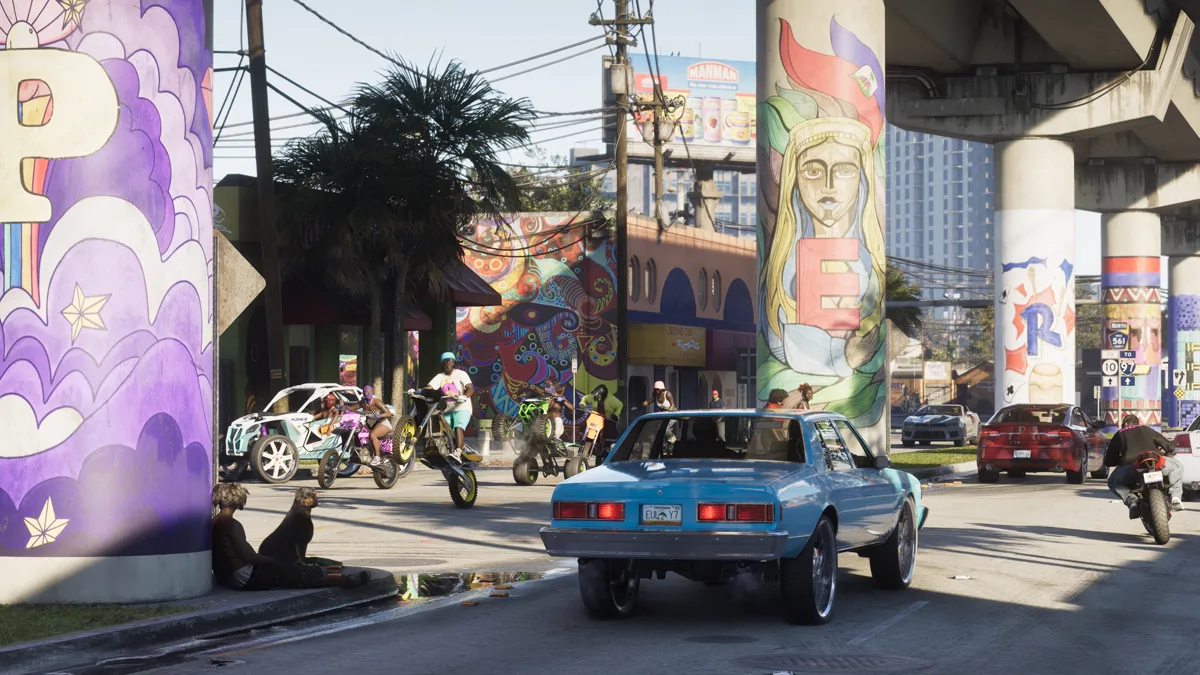
At the core, DF says, is the sheer scale of the simulation, above all the non-player characters who inhabit Vice City and the rest of Leonida. In dense places like airports and beaches there are dozens of NPCs going about their virtual lives, and the game has to be built for the worst case, not the average one. Baseline crowd behaviour is cheap to simulate. The problem is that this is GTA: sooner or later a crime happens in front of the crowd, and when the panic starts the AI load increases substantially, as NPCs turn to fight, start to flee or react in other ways, and those CPU-based calculations quickly overwhelm the frame-time budget.
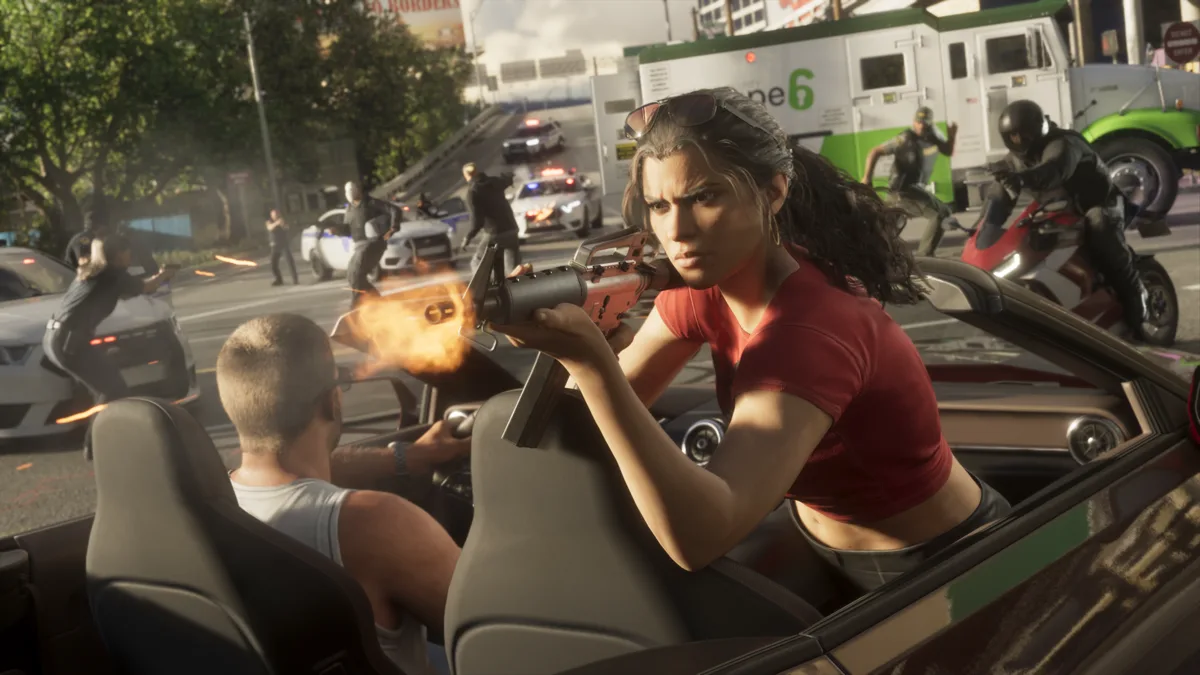
Mackenzie's airport test on Xbox Series X is the demonstration TweakTown picked out: the game holds 30 FPS while you walk through the crowds, but fire a weapon into the air and dozens of NPCs switch into their fleeing routines at once, and, in his words, "the frame rate dives into the 20s and stays there." Blowing up cars with a grenade launcher pushes the same wall from the other direction: the first destroyed car already costs frames, and the accompanying damage calculations bog the CPU down further. The police response is another AI system loading the same processor.
And it is the same processor everywhere. Every current console, base PlayStation 5, PS5 Pro and both Xboxes, runs a Zen 2 CPU, a design that launched in the PC space seven years ago and has since been superseded by three full generations. The Pro's faster graphics chip does not change that equation. DF's verdict on cutting the load in half to reach 60: "It simply wouldn't be possible to half the performance requirements to get up to that 60fps mark." The complex world cannot be shrunk down that small.
What is not the problem
The graphics side is heavy but, crucially, scalable. The game renders with hardware ray-traced global illumination, ray-traced reflections and strand-based hair across its pedestrian models, and DF notes that GPU limits can always be traded down: lower internal resolutions, fewer rays, or lower presets similar to those Xbox Series S already uses. That is why the graphics are not the primary barrier to a performance mode.
Two more loads land on the same CPU instead. Streaming a city this dense keeps the processor pegged organising the incoming assets even with high-speed SSDs and dedicated decompression hardware, and fast traversal in cars and aircraft pushes that pipeline hardest. Ray tracing adds its own processor cost during rapid movement, because the bounding volume hierarchies behind the reflections have to be coordinated for dense city blocks, moving traffic and pedestrians. DF's console testing across the week showed the spread this produces: the Series S version dropping to 720p and below 30 FPS in busy scenes (reported by TweakTown on November 18), while the stronger machines hold their 30 far more often but dip in the same CPU-bound moments.
The PC doubt
Which brings the analysis to PC. Rockstar has not announced a PC version, so everything in this section is DF's expert assessment, not a specification. Mackenzie's assessment is blunt: "I'm also doubtful that the upcoming PC version of GTA 6 will be able to run at a perfectly consistent 60fps on decent kit." DF estimates that even 200 percent of console performance would not be enough for a perfectly consistent 60 in the most demanding, CPU-limited scenes, because what those scenes need is massive per-core throughput at the moments when crowd panic and dense streaming converge, and no graphics setting turns that workload down.
The one theoretical shortcut, frame generation, gets closed off too. Generating intermediate frames from a 30 FPS baseline means bridging 33-millisecond animation gaps, which DF says introduces severe visual artefacts, and console input latency already sits around 180 milliseconds before any extra buffering. Adding frame generation's delay on top would degrade controller responsiveness toward the unplayable. DF's conclusion: the 30 FPS cap is an intentional design compromise, the price of the simulation's unprecedented scope, not an oversight waiting for a patch.
What happens next
What would change this picture: a Rockstar announcement, of a PC version, a performance mode, or a title update that reworks the simulation load. None exists at this report's last check on November 22, 2026; the current version is still 01.002.001, with no official notes. Until one of those lands, the working assumption from the best technical analysis available is that 30 is the game's number on console, and that PC players should expect a fight for 60 rather than a guarantee. The patch notes page tracks every version as it lands.
Sources
- Digital Foundry, William Judd, "Why Isn't Grand Theft Auto 6 60fps?" (published November 20, 2026), read directly: the full analysis, the NPC simulation and panic AI, the Zen 2 ceiling, the streaming and ray-tracing CPU costs, the frame generation assessment, and the conclusion that 30 FPS is a design compromise. digitalfoundry.net
- TweakTown, Jak Connor, "GTA 6 hitting a consistent 60 FPS even with PC hardware is 'doubtful'" (published November 20, 2026): the airport crowd test, the "dives into the 20s" quote, Mackenzie's PC doubt in his own words, and the 200 percent estimate. tweaktown.com
- TweakTown, coverage of Digital Foundry's console testing (November 18, 2026): the Series S version dropping to 720p and below 30 FPS, and the Series X rendering internally at about 1440p.
- Rockstar Games, pre-launch performance confirmation (November 18, 2026): 30 FPS on every console and no performance mode, the confirmed fact this analysis coverage is anchored on.
Related
Patch Notes
Every GTA VI version so far, what Rockstar has said about each, and the notes that never came.

Server Status
Whether PlayStation Network, Xbox and Rockstar's own services are up right now, fed from the official status feeds.
Interactive Map
The community map of Leonida: every collectible, business and point of interest the guides name.